




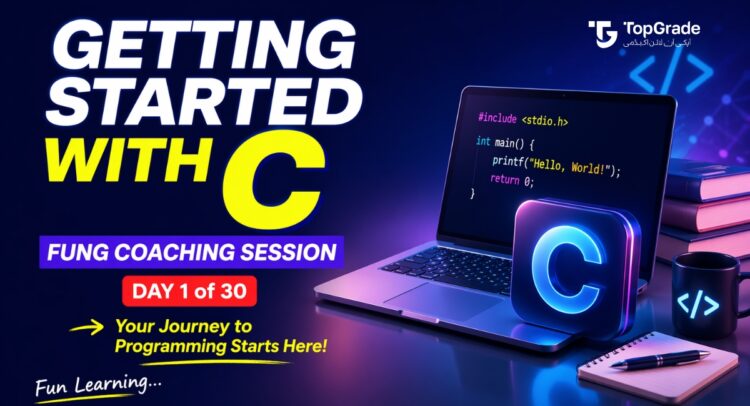
Introduction: Unlocking the Power of C Programming
Imagine you’re preparing for your entrance exams, and one of the most intimidating subjects on the list is programming. You may find yourself staring at code, unsure where to start, feeling the pressure build. But don’t worry—by mastering C programming, you’re not just preparing for exams; you’re equipping yourself with the skills that can shape your future as a software developer.
In this blog, we’ll walk you through the foundational concepts of C programming, the language that remains integral in computer science and engineering courses across universities. Whether you are tackling ECAT or other engineering university entrance exams, the knowledge of C can give you a competitive edge.
Why Learn C Programming?
C programming isn’t just any language—it’s the backbone of system software, operating systems, and embedded systems. Once you understand C, learning other programming languages like C++, Java, or Python becomes much easier.
Here are the reasons C remains a top choice for engineering students:
- Strong Conceptual Foundation: Understanding C helps build a solid foundation for software development, enabling you to understand memory management, data structures, and more.
- High Demand in Engineering: The language is a core part of most engineering curricula worldwide, making it essential for both exams and career prospects.
- Universal Application: From embedded systems in your smartphone to complex web applications, C is versatile and highly valued in multiple fields.
What You’ll Learn in This C Programming Tutorial
In this guide, we’ll break down the key topics covered in the Day One lecture of our C Programming course:
- Understanding Programs and Programming Languages
- The Difference Between Source Code and Object Code
- Language Processors: Compilers, Interpreters, and Assemblers
- The Basics of Writing C Programs
Let’s dive in.
The Basics of C Programming
1. Programs and Programming Languages
A program is simply a set of instructions given to a computer to execute a specific task. For example, when you tell a computer to “add 2 and 3,” you’re giving it a set of instructions that it must follow. This is the essence of programming.
Programming languages are tools that enable you to communicate with computers. There are two types:
- Low-Level Languages: These are closer to machine code and offer more control but are harder to learn (e.g., Assembly).
- High-Level Languages: These are easier to understand and closer to human language (e.g., C, Java, Python).
In our case, C programming is a high-level language, but it provides a good balance between low-level control and high-level ease.
2. Source Code vs. Object Code
In C programming, the source code is the human-readable code that you write. However, computers cannot understand this code directly. Therefore, it must be translated into object code, a machine-readable format.
Here’s the key takeaway: You write your program in C (source code), and then it gets compiled into object code so the computer can execute it.
3. Language Processors
When you write C programs, you’ll need a compiler, which translates the source code into machine code (object code). Think of it like a translator between you and the computer’s “language.” The interpreter, on the other hand, runs the code line by line, which is useful for debugging but slower in execution.
The assembler converts assembly language to machine code, and the linker combines different parts of the program into a final executable.
4. History of C Programming
C was developed in the early 1970s by Dennis Ritchie at Bell Labs. Its primary goal was to improve the B programming language and develop a language that could operate efficiently on early computers. Today, C is known as the “Mother of Programming Languages,” and it’s used in everything from operating systems (like Linux) to embedded systems (such as those in smartphones).
5. Basic Structure of a C Program
A simple C program follows this structure:
#include <stdio.h>
int main() {
    printf("Hello, World!");
    return 0;
}
- #include <stdio.h>: Includes the standard input/output library.
- main(): The starting point of the program.
- printf(): A function that outputs text to the screen.
- return 0;: Ends the program.
This structure is your template for writing all C programs. It may seem simple, but it forms the core of what you’ll build on as you advance in your learning.
Key Concepts for Exam Success in ECAT and Engineering University Tests
1. Bug Fixing and Debugging
Programming isn’t perfect—bugs are an inevitable part of the process. These can be:
- Syntax errors: Mistakes in code, such as missing semicolons.
- Logical errors: When the code runs but produces wrong results.
- Runtime errors: Errors that happen when the program is running, like division by zero.
Learning to debug your code is crucial for solving problems efficiently and effectively.
2. Structured vs. Unstructured Programming
C programming is structured—this means it allows you to break your code into functions and modules, making it easier to read, debug, and maintain. Unstructured programming, by contrast, can lead to tangled, unreadable code.
Practical Tips for Getting Started with C Programming
- Practice Writing Simple Programs: Start with simple programs, like printing messages to the screen or calculating basic arithmetic.
- Understand Memory Management: C gives you more control over memory, so understand how pointers work.
- Use C’s Libraries: Make the most of built-in libraries, such as
stdio.hfor input and output functions. - Keep It Neat: Maintain clean and organized code. Always use meaningful variable names and comments.
Conclusion: Embrace the Power of C
Congratulations! By learning C programming, you’ve taken the first step toward mastering one of the most essential and versatile languages in computer science. From exam success in ECAT and other engineering university tests to launching a successful software development career, C is a powerful tool in your programming toolkit.
FAQ Section
Q1: What is the first step in writing a C program?
The first step is to write the source code, using a text editor or IDE, and then save it with a .c extension.
Q2: How do I compile a C program?
Use a compiler like GCC to compile the source code into object code, which the computer can execute.
Q3: Can I use C for web development?
C is not commonly used for web development. However, it plays a significant role in system programming, embedded systems, and operating systems.
Q4: What are pointers in C?
Pointers are variables that store the memory address of another variable. Understanding pointers is crucial for advanced C programming.
Q5: Why is C so important in programming?
C provides low-level access to memory, making it an excellent choice for system-level programming and applications that require high performance.
For further assistance, join our teacher’s WhatsApp community to stay connected with fellow students and instructors. Discuss chemistry concepts, ask questions, and receive helpful updates.
And, for those looking to take the next step, if you want to give the test related to this lecture or explore more learning materials, visit the TopGrade platform for personalized study plans, test materials, and more.