




Introduction:
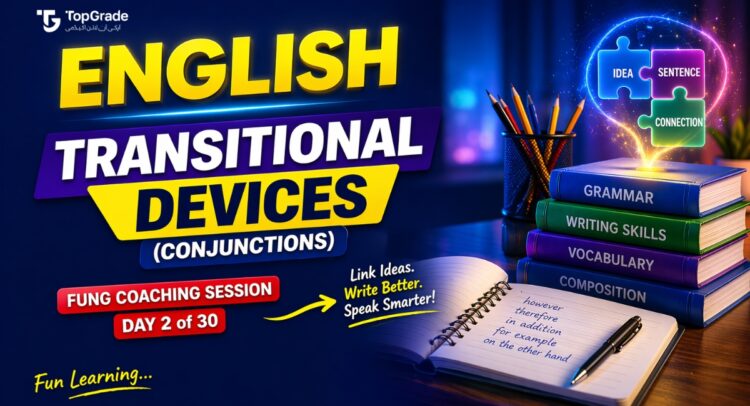
Understanding transitional devices, or conjunctions, is crucial for mastering English grammar and excelling in your ECAT or engineering university entrance exams. Whether you are trying to improve sentence coherence, enhance your writing, or boost your performance in grammar tests, transitional devices help bridge ideas smoothly. In this article, we will delve into what transitional devices are, their types, and how they are used effectively in writing. By the end, you will be equipped to apply them confidently in both written and spoken communication.
What Are Transitional Devices (Conjunctions)?
A transitional device, also known as a conjunction, is a word or phrase used to link one idea to another. They provide a logical connection between sentences, making the writing flow better. Imagine a bridge connecting two islands — that’s what these devices do to ideas in a sentence. They help make your communication more coherent and structured.
For example:
- Without transitional device: “He was very sick. He went to school.”
- With transitional device: “He was very sick; nevertheless, he went to school.”
In this example, “nevertheless” creates a logical link between the two contrasting ideas, making the sentence easier to follow.
Types of Transitional Devices
Transitional devices come in various forms, and each type serves a different function in sentence construction. Let’s take a look at the four main types:
1. Support Signal (Addition)
These transitional devices are used when you want to add more information that is similar to the previous idea.
- Words: also, moreover, in addition, furthermore, similarly, for example.
- Example: “She is intelligent. Moreover, she is hardworking.”
2. Contrast Signal
Contrast signals highlight differences or opposing ideas between two parts of a sentence.
- Words: but, yet, however, although, despite, on the other hand.
- Example: “He worked hard, yet he failed.”
3. Cause and Effect Signal
These transitional devices show the relationship between an action (cause) and its result (effect).
- Words: because, therefore, thus, as a result, consequently.
- Example: “It rained heavily. Therefore, the match was canceled.”
4. Time Sequence/Order Signal
These devices show the order in which events happened.
- Words: first, second, next, finally, afterward.
- Example: “First, wash the vegetables. Next, cut them into pieces.”
Understanding Conjunctions
Conjunctions are a subset of transitional devices that help link words, phrases, or clauses together. They fall into four main types:
1. Coordinating Conjunctions
These conjunctions connect words, phrases, or independent clauses that are of equal importance.
- Mnemonic: FANBOYS (For, And, Nor, But, Or, Yet, So)
- Example: “He worked hard, so he passed the exam.”
2. Correlative Conjunctions
These always come in pairs to connect equal parts of a sentence.
- Pairs: both…and, either…or, neither…nor, not only…but also, etc.
- Example: “She is both a teacher and a doctor.”
3. Subordinating Conjunctions
These conjunctions link an independent clause with a dependent clause, making the second clause incomplete without the first.
- Words: because, although, since, unless, if, etc.
- Example: “You will pass the exam if you study hard.”
4. Conjunctive Adverbs
These are adverbs that connect two independent clauses while indicating the relationship between them.
- Words: however, moreover, therefore, consequently, meanwhile, etc.
- Example: “She didn’t study; however, she still passed the exam.”
Practical Tips for Using Transitional Devices
Here are some practical tips for using transitional devices in your writing:
- Identify the Purpose: Before choosing a transitional device, determine what you want to convey. Are you adding more information, showing contrast, or indicating a cause and effect?
- Choose the Right Device: For example, use “yet” when you want to show contrast, and “therefore” when indicating cause and effect.
- Maintain Sentence Balance: Make sure the ideas being connected are logically linked. Overusing transitional devices can make writing feel cluttered and awkward.
- Punctuate Correctly: Pay attention to punctuation when using conjunctions. For instance, when using coordinating conjunctions to connect independent clauses, always place a comma before the conjunction.
Common Mistakes to Avoid
- Overuse of Conjunctions: Relying too heavily on conjunctions can make your writing feel repetitive and redundant.
- Incorrect Punctuation: Forgetting to use commas or semicolons with conjunctions can make sentences confusing.
- Using Weak Transitions: Avoid weak transitions like “and” when you need to show contrast or cause and effect.
Conclusion
Transitional devices, especially conjunctions, are essential tools for effective communication, especially in exams like ECAT. They help create clear, coherent sentences that smoothly link ideas together. By understanding and applying the types of conjunctions, you can improve your sentence structure, enhance your writing, and perform better in grammar tests. Don’t forget to practice using these devices regularly to master them.
FAQ Section
- What are transitional devices in English?
Transitional devices are words or phrases used to link ideas and ensure your writing flows logically. - How do conjunctions help in sentence construction?
Conjunctions connect words, phrases, or clauses, helping the sentence convey meaning more clearly and smoothly. - What is the difference between subordinating and coordinating conjunctions?
Subordinating conjunctions connect dependent clauses to independent ones, while coordinating conjunctions connect equal clauses or phrases. - Can you use transitional devices in spoken language?
Yes, transitional devices are often used in speech to clarify relationships between ideas. - How can I improve my use of transitional devices?
Practice identifying the purpose of your ideas and choose the appropriate transitional device to link them clearly and logically.
For further assistance, join our teacher’s WhatsApp community to stay connected with fellow students and instructors. Discuss chemistry concepts, ask questions, and receive helpful updates.
And, for those looking to take the next step, if you want to give the test related to this lecture or explore more learning materials, visit the TopGrade platform for personalized study plans, test materials, and more.